A clogged nozzle rarely announces itself. It sits above the cooking line collecting grease, vapor residue, and contamination until an inspection, a discharge test, or a fire exposes the problem. In commercial kitchens, knowing cómo limpiar boquillas de supresión is not a housekeeping detail. It is a life safety issue tied directly to system performance, code compliance, and business continuity.
For restaurants, hotels, resorts, and institutional kitchens, nozzle condition affects whether wet chemical agent reaches the protected hazard the way the system was engineered to do. If a cap is missing, if grease has migrated into the orifice, or if the wrong cleaning method has altered the nozzle, the suppression system may fail to distribute agent correctly. That can mean expanded fire damage, failed inspections, insurance complications, and operational shutdown.
Why nozzle cleaning is more technical than it looks
In a commercial kitchen fire suppression system, nozzles are not generic fittings. They are listed discharge components selected by manufacturer, flow point, appliance type, and coverage pattern. ANSUL, Kidde, PyroChem, Range Guard, Captive Air, and ProTex systems use specific nozzle configurations that must remain matched to the design.
That is why cleaning cannot be treated like routine degreasing of a hood surface. The goal is not to make the nozzle look polished. The goal is to keep the discharge path unobstructed without changing the nozzle opening, damaging the blow-off cap, contaminating the piping connection, or compromising listing requirements.
Under NFPA 17A and NFPA 96 maintenance expectations, nozzle inspection is part of a broader suppression system service program. In practice, that means cleaning must be paired with verification – cap condition, alignment, obstruction status, appliance coverage, and evidence that no unauthorized modification has occurred.
Cómo limpiar boquillas de supresión without creating risk
The first rule is simple: clean the exterior contamination, not the internal discharge geometry, unless the work is being performed as part of qualified suppression system service. If your team is doing day-to-day sanitation, they should remove grease around the nozzle carefully and report damage or buildup, not improvise repairs.
Start by confirming that the kitchen staff understands which components belong to the fire suppression system. Nozzles are often mistaken for grease residue traps, mounting hardware, or removable spray heads. They are none of those things. They must stay in place, correctly oriented, and protected by their listed caps or covers.
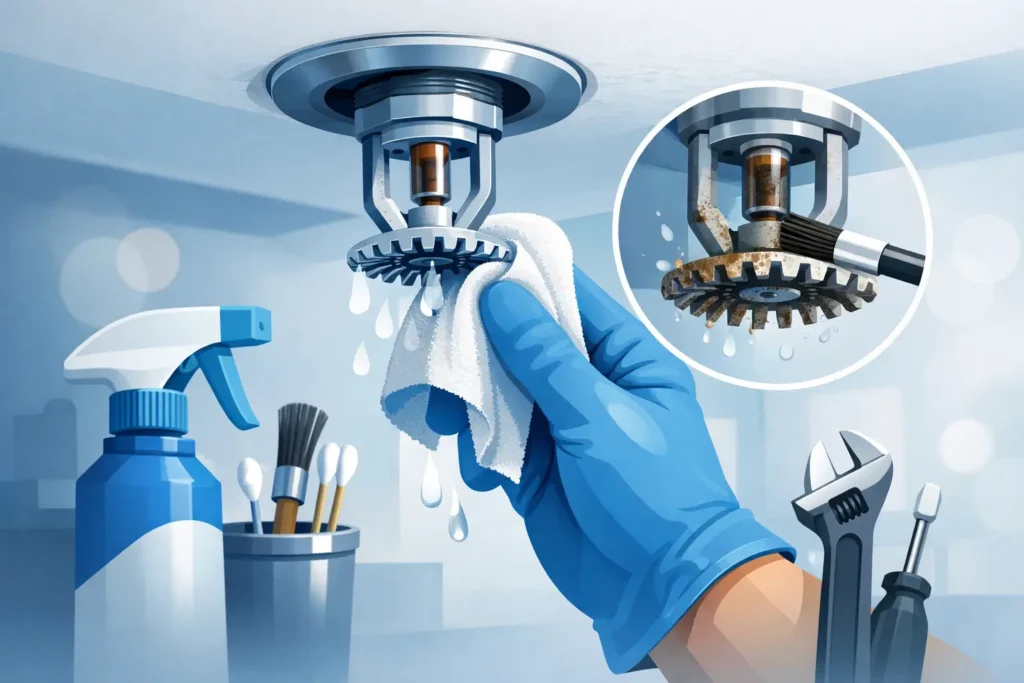
Before any cleaning begins, the area should be cool and accessible. Do not clean around active hot appliances or while line operations are in progress. Use a clean cloth with a non-corrosive degreasing solution approved for kitchen surface cleaning. Wipe the outside of the nozzle body gently to remove visible grease film. Avoid aggressive scrubbing pads, metal brushes, picks, knives, or drills. Those methods can deform the nozzle, scratch critical surfaces, or push residue into the orifice.
If the nozzle has a blow-off cap, do not remove it casually. That cap serves a purpose – it helps keep grease and contaminants out of the discharge opening until activation. Missing caps are a common deficiency in commercial kitchens, and they should be corrected with the proper manufacturer-approved component, not a substitute.
When buildup is heavy, the right response is usually not harder cleaning. Heavy accumulation often indicates a larger maintenance issue involving poor hood and duct cleaning intervals, weak sanitation controls, or overdue suppression service. In those cases, forcing residue off the nozzle can hide the symptom without correcting the condition.
What kitchen staff can do and what belongs to a certified technician
There is a practical line between sanitation and technical service. Kitchen staff can wipe exterior grease from accessible nozzle surfaces as part of routine cleaning, provided they do not rotate, loosen, remove, or probe the nozzle opening. They can also report missing caps, bent nozzles, corrosion, paint overspray, or obstructions caused by foil, trays, aftermarket shelves, or equipment relocation.
A qualified fire suppression technician should handle anything beyond that. This includes removing and inspecting nozzles, checking for internal blockage, confirming proper nozzle type and direction, replacing caps, verifying appliance coverage, and documenting the condition as part of a compliant inspection. If the system requires disassembly, recharge, mechanical actuation review, or manufacturer-specific service procedures, that is not a janitorial task.
This distinction matters because many nozzle problems are created during well-intended cleaning. Staff members sometimes twist nozzles out of alignment while wiping overhead surfaces. Others remove caps and forget to reinstall them. In some kitchens, a maintenance worker uses wire to clear a suspected blockage, damaging the orifice and changing the discharge characteristics. The nozzle may still look functional, but its performance is no longer reliable.
Common mistakes when cleaning suppression nozzles
The most frequent error is treating the nozzle like a grease fitting that just needs to be opened up. It does not. Any action that changes the opening or introduces foreign material into it can compromise discharge.
Another common mistake is spraying chemicals directly upward into the nozzle. Strong cleaners can leave residue, affect cap integrity, or migrate into sensitive components. The safer method is applying cleaning solution to the cloth first and then wiping the external surface.
Painting is another recurring issue during renovations. Nozzles painted over, taped off incorrectly, or coated with finish material become serious deficiencies. Even a thin layer can affect cap release or nozzle identification. If painting or ceiling work is taking place near the hood and plenum area, suppression components need to be protected correctly and then rechecked before the kitchen returns to service.
Relocated appliances also create hidden problems. A nozzle may be clean, but if the protected appliance has shifted even a few inches, the discharge pattern may no longer align with the hazard. Cleanliness alone does not equal compliance.
Inspection points that matter more than appearance
When evaluating nozzle condition, a technician is looking beyond visible grease. The questions are operational. Is the nozzle the correct type for the appliance below it? Is it aimed according to the manufacturer design? Is the cap present and intact? Is there evidence of blockage, corrosion, impact, or unauthorized change? Is the appliance line still consistent with the original protection layout?
In high-volume hospitality kitchens, especially where fryers, charbroilers, wok stations, and tilt skillets generate heavy grease vapor, these checks should be part of a scheduled preventive maintenance program. Waiting until an annual review or a failed inspection creates unnecessary exposure.
Documented service also matters. For insurance support, authority having jurisdiction review, brand standard audits, and internal risk management, it helps to have clear records showing nozzle inspection, cleaning status, deficiencies found, and corrective actions completed. A serious contractor will treat nozzle condition as part of the full suppression system readiness picture, not as an isolated cosmetic issue.
How often should boquillas de supresión be checked?
There is no responsible one-size-fits-all answer. It depends on cooking volume, grease load, equipment type, cleaning discipline, and the age and condition of the suppression system. A hotel banquet kitchen running long production hours has a different contamination profile than a small café with limited fry operations.
As a baseline, nozzles should be visually checked during regular kitchen sanitation rounds and formally inspected during scheduled suppression system service. If your facility has repeated grease accumulation, frequent line changes, or a history of failed inspections, shorter review intervals are justified. The cost of more frequent verification is minor compared with the cost of discharge failure or a temporary shutdown.
For many operators, the better question is not just how often to clean, but how often to inspect, document, and correct. That is where a compliance-driven service partner adds value. Companies such as Fire Patrol build nozzle inspection into a broader maintenance and audit-readiness process that supports NFPA expectations, operational uptime, and defensible records.
When cleaning is not enough
If a nozzle is obstructed internally, damaged, heavily corroded, missing its cap, coated with paint, or no longer matched to the appliance layout, cleaning is no longer the solution. The condition must be corrected according to manufacturer requirements and system design criteria.
The same applies when other system indicators are present – overdue fusible link replacement, questionable cylinder pressure, poor alarm interface status, unverified mechanical actuation, or undocumented prior service. Nozzles are only one discharge point in a larger protection system. Their condition should trigger a broader look at readiness.
A commercial kitchen does not get credit for having a suppression system on paper. It gets protection only when every component is clean enough, intact enough, and correctly maintained enough to perform under fire conditions. If your team is asking cómo limpiar boquillas de supresión, the most useful next step is to pair careful sanitation with qualified inspection, because the nozzle that looks acceptable from the floor is not always the nozzle that will discharge correctly when seconds matter.