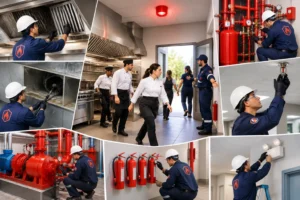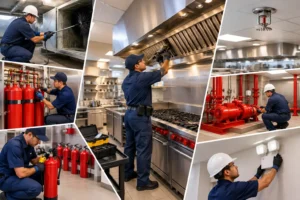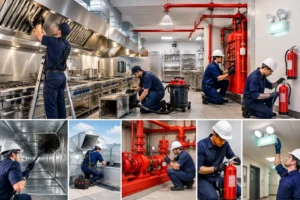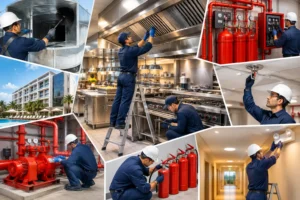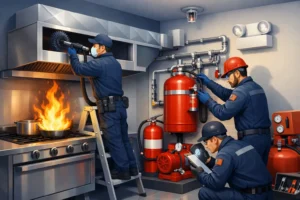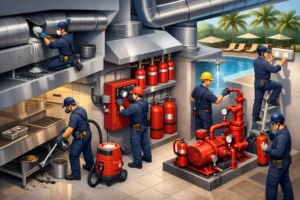
A failed kitchen inspection rarely starts with one major defect. More often, the top causes of kitchen fire code violations are routine maintenance gaps that build up over time – grease accumulation, blocked nozzles, missing records, impaired pull stations, and suppression components that were never serviced on schedule. In commercial kitchens, those issues do more than trigger citations. They increase the chance of fire spread, insurance disputes, equipment damage, and operational shutdown.
For restaurants, hotels, resorts, commissaries, and institutional kitchens, the real problem is not just noncompliance. It is loss of control. Once fire protection tasks become reactive instead of scheduled, violations tend to multiply across the hood, duct, suppression system, gas shutoff, alarms, and housekeeping practices. That is why code compliance has to be treated as an operating discipline, not a one-time inspection event.
Why kitchen fire code violations happen so often
Commercial kitchens operate under constant heat, grease vapor, cleaning pressure, and production demands. Even well-run facilities can drift out of compliance when maintenance is split across vendors, inspection records are incomplete, or staff assume the suppression system will work because it is present. Presence is not the same as readiness.
NFPA 96 and NFPA 17A set the baseline for ventilation control, grease removal, and wet chemical fire suppression performance. In practice, most violations occur where those systems meet daily kitchen activity. A hood may be installed correctly but become hazardous because grease is left in the plenum. A suppression tank may be in place but fail inspection because pressure is out of range, caps are missing, or nozzles are obstructed. The code issue is visible at inspection, but the root cause is usually poor preventive control.
Top causes of kitchen fire code violations in commercial facilities
Grease buildup in hoods, ducts, and exhaust components
This is one of the most common and most serious findings in commercial kitchens. Grease is fuel. When it accumulates in the hood interior, filters, ductwork, and exhaust fan system, a small appliance flare-up can extend into the ventilation path and spread rapidly beyond the cooking line.
The trade-off here is operational. High-volume kitchens often delay cleaning because access is inconvenient or because service is scheduled around occupancy. That delay becomes expensive fast. Inspectors do not treat visible grease as cosmetic. They treat it as evidence that the fire risk is increasing and that the exhaust system may no longer be performing as intended.
Areas above the hood line are also frequently missed. Operators may clean visible surfaces daily while hidden duct sections, fan housings, and rooftop exhaust areas continue to collect combustible residue. That gap is where many violations begin.
Blocked, capped, or contaminated suppression nozzles
A wet chemical suppression system depends on proper agent discharge at the hazard area. If nozzle caps are missing, grease can contaminate the opening. If nozzles are painted over, misaligned, or obstructed by equipment changes, the discharge pattern may not cover the appliance correctly.
This is a technical issue with major consequences. A system can appear intact and still fail to protect the fryer, range, griddle, or charbroiler during an actual event. Nozzle condition should never be judged casually. It requires inspection against the appliance layout, manufacturer design, and code requirements.
Equipment line changes are a frequent trigger. A kitchen adds or replaces cooking equipment, but the suppression layout is not updated. The result is a mismatch between protection design and actual hazard location.
Overdue fusible link replacement and missed system service intervals
Fusible links are small components, but they play a critical role in automatic actuation. When they are not replaced at the required interval, or when they are coated with grease and residue, their reliability becomes questionable. The same applies to neglected cylinder reviews, mechanical actuation checks, and overall suppression system servicing.
One common misconception is that if the system has not discharged, it does not need attention. That is not how compliance works. Kitchen suppression systems require periodic inspection, testing, and documented maintenance to remain code-compliant and operationally dependable.
Missed service intervals also create a documentation problem. During an audit, if there is no current inspection tag, no service report, or no evidence of required replacement and testing, the kitchen may be treated as noncompliant even before a physical defect is confirmed.
System impairments that inspectors flag quickly
Manual pull stations that are inaccessible or improperly identified
Manual activation is a basic life safety function. If a pull station is blocked by storage, hidden behind equipment, mislabeled, or damaged, staff may lose valuable seconds during a fire event. In a working kitchen, those seconds matter.
This issue often comes from layout drift. Over time, operators add shelving, move carts, stack supplies, or reposition appliances. What was accessible during installation no longer is. The violation is easy for an inspector to spot and easy for a facility to prevent if the kitchen is reviewed routinely.
Gas valve, fuel shutoff, or electrical interlock deficiencies
When a suppression system activates, connected fuel and electrical sources typically must shut down as designed. If those interlocks are missing, disconnected, or not tested, the hazard remains active even after agent discharge. That is a major compliance and safety concern.
This category deserves special attention in older kitchens and renovated spaces. It is not unusual to find suppression equipment that was maintained separately from the fuel shutoff controls or alarm interface. Each component may look serviceable on its own, but the system as a whole has not been verified.
Poor alarm integration and monitoring gaps
In many commercial environments, suppression discharge must communicate properly with the fire alarm system under applicable requirements. If alarm integration is absent, impaired, or undocumented, the kitchen may face both code issues and delayed emergency response.
This is where fragmented vendor management creates risk. Hood cleaning, fire alarm service, suppression maintenance, and general kitchen repairs are often handled by different providers. Without coordination and technical reporting, nobody confirms that the systems function together.
Housekeeping and operational practices that create repeat violations
Improper storage near cooking equipment
Combustible items stored near fryers, ranges, ovens, or under the hood are still a frequent violation. Cardboard, paper products, cooking oil containers, linens, and disposable packaging can all contribute to rapid fire extension.
The challenge is practical. Kitchens are tight on space, and temporary storage tends to become permanent. Inspectors know that. If combustibles are routinely found in protected cooking zones or near ignition sources, the issue is not just clutter – it signals weak control over fire exposure.
Damaged or missing hood filters
Filters are part of the fire defense strategy, not just the ventilation system. When filters are missing, installed incorrectly, or damaged, grease can move deeper into the duct system and increase ignition potential. Airflow may also be affected, which can worsen heat and vapor conditions around the cooking line.
This is another area where rushed cleaning practices create problems. Filters removed for washing must be reinstalled correctly and consistently. A single missing section can become a visible code violation and a hidden fire path.
Staff training failures
Even a compliant system can be undermined by poor staff response. If kitchen personnel do not know how to report a system impairment, use a manual pull station, recognize blocked nozzles, or keep the protected area clear, small defects can persist until inspection day or until a fire exposes them.
Training does not need to be complicated, but it must be specific to the kitchen environment. General safety orientation is not enough for high-heat cooking operations with wet chemical suppression and exhaust fire hazards.
How to reduce the top causes of kitchen fire code violations
The most effective approach is a scheduled compliance program built around inspection, cleaning, corrective action, and documentation. That means hood and duct cleaning at the proper frequency, suppression system service by qualified technicians, fusible link replacement, nozzle inspection and cleaning, cylinder pressure review, manual pull station verification, and confirmation that alarms and fuel shutoffs operate as required.
It also means documenting what was found, what was corrected, and what still needs action. Photographic evidence, service reports, and inspection records matter because they show control. For multi-unit operators and hospitality groups, that recordkeeping is often what separates a manageable deficiency from a larger insurance or audit problem.
There is no single defect behind most kitchen fire code failures. It is usually a chain of smaller issues left unresolved. A disciplined preventive maintenance plan breaks that chain before it affects service, safety, or occupancy. Companies such as Fire Patrol focus on this exact gap – keeping commercial kitchens inspection-ready with technical service, standards-based checks, and documented corrective follow-through.
The best time to fix a kitchen fire code issue is before an inspector, insurer, or fire event exposes it. When fire protection is treated like a core operating system, compliance stops being a scramble and becomes part of how the kitchen stays open.