A six-burner range can keep cooking even after the exhaust fan fails. That is exactly why a gas shutoff interlock commercial kitchen setup is not just another accessory on the wall. In a high-heat foodservice environment, it is a control measure that ties fuel supply to ventilation and fire protection response, reducing the chance that an equipment fault turns into a shutdown, an injury, or a major loss.
For restaurant owners, hotel engineers, executive chefs, and facility managers, this device sits at the intersection of life safety, code compliance, and operational continuity. If it is missing, bypassed, poorly wired, or never tested after installation, the kitchen may be exposed in ways that are not obvious during daily service. Problems usually appear during an inspection, an alarm event, or after a fire.
What a gas shutoff interlock commercial kitchen system does
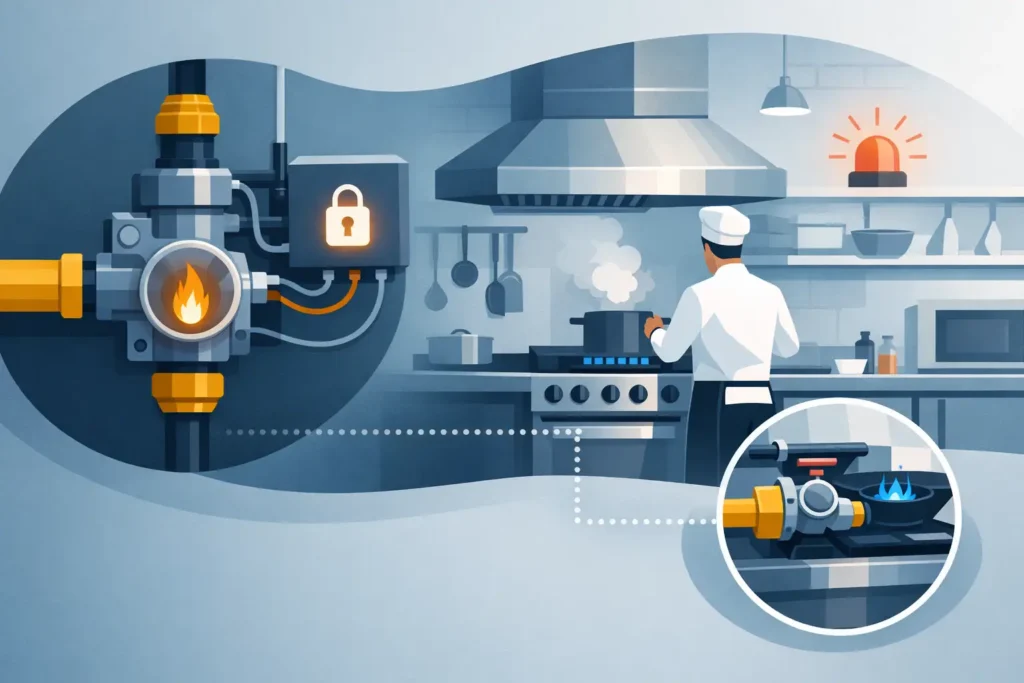
In simple terms, the interlock monitors required operating conditions and removes gas to cooking equipment when those conditions are not met. The exact sequence depends on the design, but in most commercial kitchens the interlock is tied to exhaust airflow, makeup air, fire suppression system status, emergency stop functions, and sometimes building alarm interfaces.
If the exhaust fan fails, the interlock can close the gas valve so fuel-fed appliances do not continue operating without proper ventilation. If the wet chemical suppression system discharges, the interlock should shut down gas service to protected appliances as part of the fire event sequence. This is a critical control because fire suppression is only one part of the response. The energy source feeding the hazard also has to stop.
That sounds straightforward, but field conditions are rarely that simple. Older kitchens may have equipment added over time, multiple contractors involved, and undocumented changes to wiring or controls. In those sites, the interlock may exist on paper but not function as intended.
Why this matters for compliance and inspections
Commercial kitchen fire protection is governed by a combination of mechanical, electrical, fire, and fuel gas requirements. NFPA 96 and NFPA 17A are central references in kitchen exhaust and wet chemical suppression work, and interlocks often become part of how those systems achieve compliant shutdown behavior.
Inspectors and insurance representatives are not only looking for the presence of a fire suppression system. They want to see that protected appliances shut down correctly, gas valves operate as required, manual pull stations function, and connected alarms or supervisory signals perform properly where applicable. A kitchen with a recently tagged suppression system can still fail an inspection if the gas valve does not close when the system trips.
That distinction matters. A certified-looking system is not the same as a fully functional one.
Where interlock failures usually happen
Most failures do not start with the gas valve itself. They start with neglect, undocumented modifications, or partial service by vendors focused on one trade only.
A hood contractor may replace fan controls without confirming the gas interlock sequence. An appliance installer may reconnect equipment after a renovation and leave the interlock bypassed to avoid nuisance shutdowns. A fire system may be serviced correctly, but no full functional test is performed between suppression release, microswitch action, alarm interface, and fuel shutoff.
Grease, heat, vibration, and moisture also take a toll. Valve assemblies, relays, pressure switches, cable runs, and junction boxes live in a harsh environment. Even when they are installed properly, they need periodic inspection and testing. A kitchen that runs long hours at high volume places more stress on these components than a light-duty operation, so maintenance intervals should reflect actual use, not assumptions.
Interlock testing is not optional
A gas shutoff interlock commercial kitchen assembly should be tested as part of a broader preventive maintenance and inspection program. That means more than pushing a button and seeing a light change color. The test should confirm the actual operating sequence under realistic conditions.
The technician should verify that fan status inputs are working, that the gas solenoid or valve changes state correctly, that the suppression system microswitch activates the shutdown path, and that any connected alarm outputs behave as designed. If there is an emergency stop station, it should also be tested for proper shutdown response.
Documentation matters here. For audit readiness and liability control, operators should have service records showing what was tested, what passed, what failed, and what corrective action was taken. Photographic evidence and written reporting are especially valuable when corporate safety teams, insurers, or local authorities ask for proof of system condition.
Common design questions from operators
One of the most common questions is whether every gas appliance needs to be tied into the interlock. The answer depends on the kitchen layout, the protected hazard area, local code enforcement, and the approved system design. Appliances under a protected hood and served by gas are usually part of the conversation, but the final configuration should follow the listed system requirements and authority having jurisdiction.
Another common issue is nuisance trips. Operators sometimes complain that the system cuts gas during startup or after power fluctuations. That can point to poor sequence programming, failing airflow proving devices, unstable controls, or improper field modifications. The fix is not to bypass the system. The fix is to diagnose why the sequence is unstable and correct it.
There is also the retrofit question. Many older kitchens were not built around current expectations for integrated controls. Retrofitting an interlock can be very achievable, but it must be approached carefully. Existing suppression equipment, hood controls, fan starters, gas train components, and alarm interfaces all need to be reviewed as one system, not as isolated parts.
Installation quality affects real-world safety
An interlock is only as reliable as its installation and commissioning. Correct component selection matters, but so do wiring practices, valve orientation, labeling, accessibility, and final testing. A poorly placed valve can complicate service. Unlabeled disconnects create confusion during emergency response. Missing as-built documentation makes future repairs slower and riskier.
This is where specialized commercial kitchen service matters. A general contractor or low-voltage vendor may understand part of the job, but kitchens protected by wet chemical systems require coordination between suppression, ventilation, gas controls, and in some cases alarm reporting. When that coordination is weak, the kitchen inherits the risk.
For hospitality operations, the stakes are higher than a failed inspection tag. A mismanaged shutdown event can interrupt meal service, affect guest experience, trigger emergency calls, and create insurance questions after a loss. Preventive attention is less disruptive than emergency correction.
What operators should ask during service
When your provider inspects the suppression system or hood controls, ask whether the gas shutoff sequence was functionally tested, not just visually reviewed. Ask whether the manual pull station, microswitches, gas valve, fan interlocks, and alarm connections were included in the test. Ask for written results.
If your site has had a remodel, equipment replacement, or recurring control issues, ask for a full verification of the interlock logic. Changes in one part of the kitchen often affect another. A new appliance line, replacement fan motor, or updated control panel can alter a sequence that previously worked.
This is also the right time to confirm whether records are current. If your team cannot quickly produce documentation for inspection, you are already behind.
A compliance-first approach reduces shutdown risk
In a commercial kitchen, gas flow, exhaust performance, and fire suppression response cannot be treated as separate systems. They are linked operationally, and they need to be maintained that way. A gas shutoff interlock commercial kitchen configuration provides a critical layer of protection, but only when it is correctly installed, routinely tested, and documented with the same discipline applied to the rest of the fire protection program.
For operators managing audit pressure, brand standards, and nonstop production, this is not about adding complexity. It is about removing blind spots. If there is any doubt about how your kitchen interlock performs, a qualified inspection can clarify the condition before an inspector, insurer, or emergency event does. Fire Patrol supports that process with kitchen-focused service, code-based testing, and documented reporting built for high-accountability foodservice environments.
The safest time to verify a shutdown sequence is when the kitchen is operating normally, not when the system has already been forced to respond.