A grease fire in a commercial kitchen does not give your team time to debate equipment. It tests whether the installed protection matches the actual cooking hazard, whether the nozzles are clean and aligned, whether the fuel shutoff works, and whether the system will discharge exactly as designed. When operators search for tipos sistemas supresión cocinas, what they usually need is not a generic list. They need to know which system is appropriate for their kitchen, what code expects, and where failures typically start.
In commercial foodservice, the discussion is narrower than many people assume. Not every fire suppression technology is acceptable over cooking appliances, and not every kitchen has the same hazard profile. A system protecting a light-duty pantry line is not evaluated the same way as one covering high-volume fryers, charbroilers, and wok ranges. The correct selection affects life safety, property protection, business continuity, insurance position, and inspection outcomes.
What the main tipos de sistemas de supresión en cocinas really are
In the US commercial kitchen environment, the primary fire suppression method for grease-producing cooking operations is the wet chemical system. This is the standard solution used to protect hoods, ducts, plenum areas, and surface cooking appliances in accordance with the hazard and applicable codes, particularly NFPA 17A and NFPA 96.
Wet chemical systems are engineered for cooking media fires involving animal fats and vegetable oils. Their discharge agent is designed to cool the fire, react with hot grease, and help prevent reflash. That matters because a kitchen fire is rarely just an open flame problem. It is a heat retention and fuel continuity problem. If the agent does not address both, the risk remains active even after visible flames appear controlled.
You may also hear people mention dry chemical systems, water mist, or clean agent systems when discussing fire protection. Those technologies have specific uses in the broader fire protection field, but they are not interchangeable with listed wet chemical kitchen suppression systems for commercial cooking hazards. In practical terms, for protected restaurant and hospitality cooking lines, wet chemical is the benchmark because it is specifically listed and applied for that purpose.
Wet chemical systems: the industry standard for commercial cooking
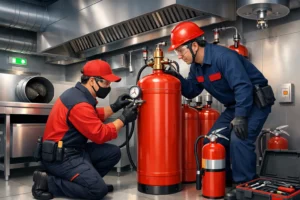
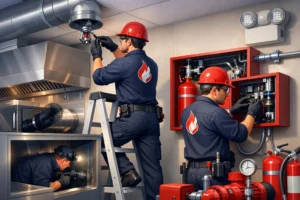
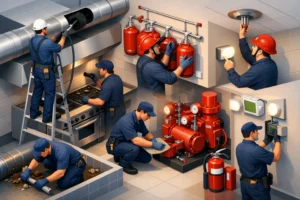
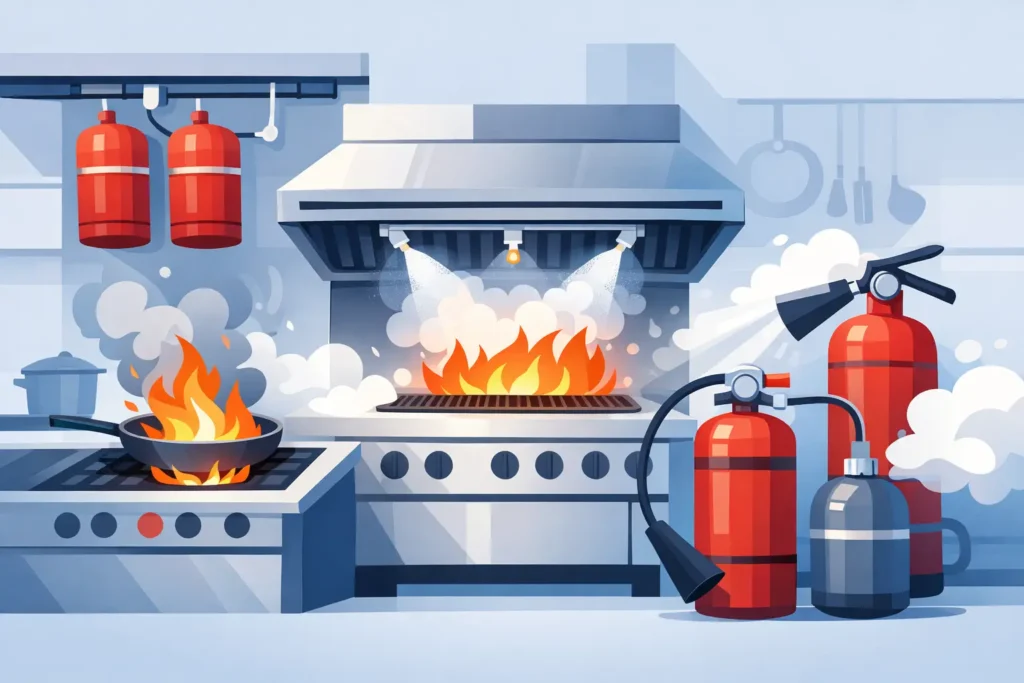
A wet chemical system protects the exhaust hood, duct collar or duct run as applicable, and each appliance hazard area through a network of nozzles, detection components, manual pull station, agent cylinder, and mechanical or electrical shutdown interfaces. Once activated, the system discharges agent through fixed nozzles and typically also shuts down fuel or electrical power to protected cooking equipment.
That shutdown function is not an accessory. It is part of the life safety sequence. If gas valves fail to close or electrical interlocks do not operate, the suppression discharge may not fully control the event. This is one of the most common areas where systems appear complete on paper but fail operationally during testing or during an actual incident.
Within wet chemical systems, there are manufacturer-specific designs such as ANSUL, Kidde, PyroChem, Range Guard, Captive Air, and ProTex configurations. These brands are not just labels on a cylinder. Each listed system has its own appliance coverage limits, nozzle types, pipe network rules, detection setup, and service procedures. Mixing components or improvising field changes outside the manufacturer listing can create compliance issues and, more seriously, can compromise performance.
Appliance-specific protection matters
Not all cooking appliances produce the same fire behavior. Fryers hold deep reservoirs of oil and often require highly specific nozzle placement and coverage overlap. Griddles and ranges present different surface fire characteristics. Charbroilers introduce flare-up behavior, elevated heat, and grease vapor loading. Woks can create intense localized plume conditions. Solid-fuel cooking adds another layer of complexity and may require additional design consideration beyond a standard line setup.
This is why system selection should start with the actual cooking battery, not with a one-size-fits-all package. If appliances are moved, replaced, added, or removed, the suppression layout may also need modification, re-evaluation, or re-listing support. Many failed inspections begin with an equipment change that was never matched by a suppression update.
How kitchen suppression systems are commonly classified
For operators comparing tipos sistemas supresión cocinas, the most useful classification is by hazard application rather than by marketing language.
Pre-engineered wet chemical systems
These are the most common systems in restaurants, hotels, resorts, institutional kitchens, and catering operations. They are designed according to manufacturer listings and installation manuals for defined appliance types, hood dimensions, nozzle selections, pipe lengths, and agent capacities. Their advantage is that they are practical, code-recognized, and suitable for most standard commercial cooking arrangements.
Pre-engineered does not mean generic. The installer still has to match the design to appliance configuration, hood geometry, and required shutdown logic. If any of those elements are wrong, the system may be installed but not properly protecting the hazard.
Engineered or custom application conditions
Some larger or more specialized kitchen environments require a more tailored approach because of unusual hood lengths, appliance density, fuel type, or facility integration requirements. Even then, the protection over grease-producing appliances remains centered on listed wet chemical technology. The difference is in how the system is configured, zoned, interfaced with alarms, and documented.
This often applies in large hospitality properties and high-output production kitchens where suppression cannot be treated as a standalone item. It has to coordinate with alarm reporting, shutdown controls, maintenance access, and operational continuity planning.
What code and inspection teams care about most
The right system type is only the starting point. Compliance depends on condition, testing, and documentation. Inspectors, insurers, and fire officials do not evaluate kitchen suppression based on whether a cylinder is present. They evaluate whether the entire system is listed, maintained, accessible, and capable of operating as intended.
NFPA 96 establishes the broader fire protection requirements for commercial cooking operations, including inspection and maintenance expectations for extinguishing systems, exhaust systems, and hazard conditions related to grease accumulation. NFPA 17A addresses wet chemical extinguishing systems specifically. Together, these standards shape the baseline for inspection readiness.
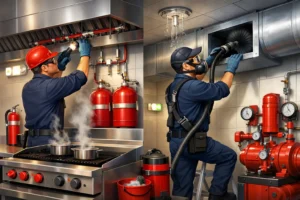
From a field-service standpoint, recurring issues include obstructed nozzles, missing nozzle caps, grease contamination, low cylinder pressure where applicable, damaged pull stations, overdue fusible link replacement, disconnected gas shutoff, and undocumented appliance changes. Any one of these issues can turn a compliant-looking system into a failed protection layer.
Maintenance intervals are not optional
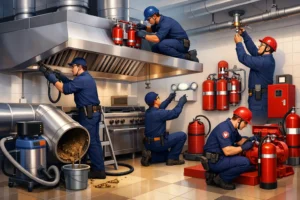
Commercial kitchen suppression systems require regular inspection and maintenance, commonly on a semiannual basis, along with service after discharge, after appliance changes, and whenever damage or tampering is observed. The service event should not stop at a visual check. It should verify detection condition, fusible links where installed, actuation path, cylinder status, nozzle condition, pipe integrity, and shutdown functionality.
Operators managing multiple properties should also insist on documented reporting with clear findings, corrective actions, and photographic evidence. That record supports audits, internal safety tracking, and insurance questions after an event.
Choosing the right system for your kitchen
The correct decision depends on cooking process, appliance lineup, hood design, fuel source, local enforcement expectations, and how the facility manages preventive maintenance. A quick-service concept with multiple fryers has a different risk profile than a hotel banquet kitchen with mixed equipment and seasonal production spikes. A resort kitchen operating long hours with limited downtime may place even greater value on disciplined inspection scheduling and corrective coordination.
The most costly mistake is assuming that an existing system is adequate because it has not discharged. Non-discharge does not prove suitability. It may simply mean the hazard has not yet tested the system.
A better approach is to evaluate whether the installed wet chemical system is listed for the exact appliances under the hood, whether the detection and release sequence still matches the current layout, whether alarm integration is required or already present, and whether service records would stand up to an audit. That is the level of review commercial kitchens need if they want real protection instead of checkbox compliance.
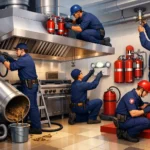
For operators in hospitality and foodservice, this is where a kitchen-focused contractor adds value. A provider such as Fire Patrol is not just looking at hardware. The work has to connect suppression, hood and duct condition, shutdown controls, inspection frequency, code references, and documented corrective action into one operational safety program.
The system over your cookline should do more than satisfy a line item on an inspection form. It should be correctly matched to the hazard, maintained to standard, and ready to operate on the worst day of your kitchen’s year. If there is any doubt about that, the right time to address it is before the next audit, before the next service interruption, and before the next fire starts under the hood.