A failed discharge test rarely starts with the test itself. In most commercial kitchens, the warning signs show up earlier – grease-loaded nozzles, damaged caps, low cylinder pressure, blocked appliance layout, overdue fusible links, or paperwork that does not support compliance. A proper kitchen fire suppression maintenance checklist is not just a service form. It is a control measure that protects life safety, keeps the system ready to operate, and supports inspection, audit, and insurance requirements.
For restaurants, hotels, resorts, commissaries, and institutional food operations, the risk is operational as much as it is technical. If a wet chemical system does not activate correctly over fryers, ranges, or charbroilers, the result can be structural damage, service interruption, failed audits, and questions from insurers after a loss. That is why maintenance has to be disciplined, documented, and aligned with NFPA 17A and NFPA 96 requirements.
What a kitchen fire suppression maintenance checklist should cover
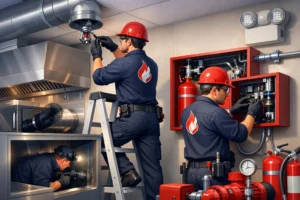
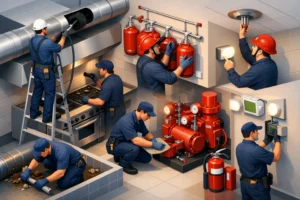
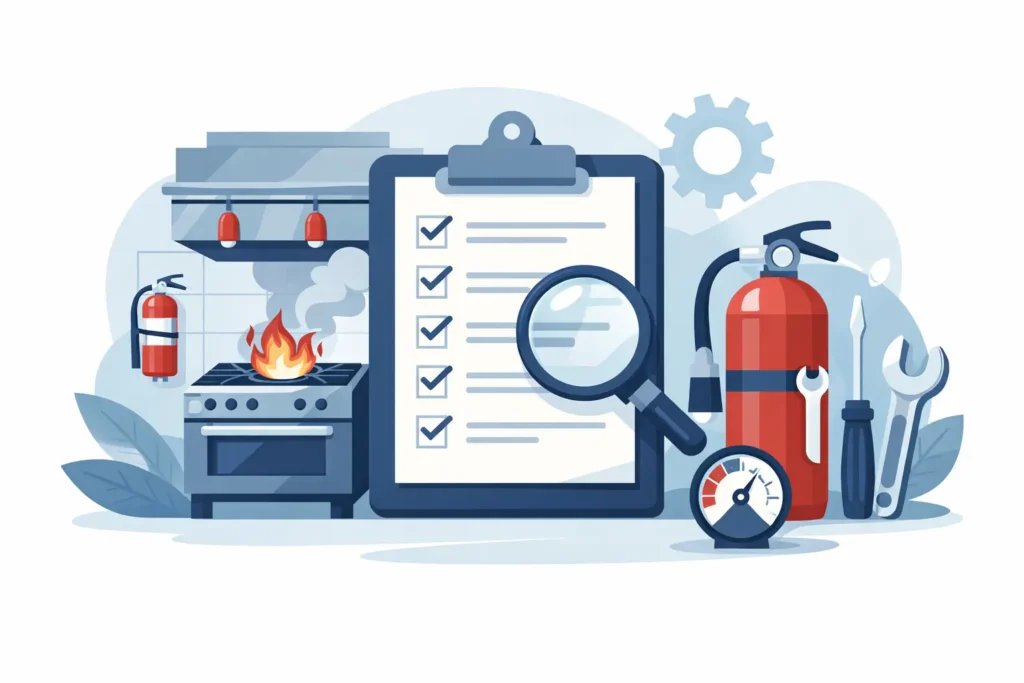
A useful checklist does more than confirm the system is «present.» It verifies that the entire protection sequence can function as designed. That includes detection, actuation, agent storage, discharge path, appliance coverage, manual pull access, fuel shutoff, alarm interface, and service documentation.
In practical terms, the checklist should confirm the system is matched to the current cooking hazard. That point is often missed. Kitchens evolve quickly. Equipment gets replaced, moved, or added, and the suppression layout may no longer protect the actual hazard footprint. A newly installed fryer or broiler can create an exposure gap even when the original system components still look intact.
Maintenance also has to separate housekeeping issues from system defects. Heavy grease accumulation inside the hood or on nozzles can impair performance, but grease removal is not the same as suppression servicing. Both matter, and both need to be controlled together if the kitchen is expected to pass inspection and remain protected during operation.
Kitchen fire suppression maintenance checklist for commercial kitchens
Verify the protected appliances and hazard configuration
Start with the cooking line. Confirm every appliance under the hood matches the suppression design and nozzle coverage. Fryers, griddles, ranges, woks, charbroilers, and upright broilers do not present the same hazard profile, and nozzle selection matters. If equipment has been relocated, replaced, or added, the system may require redesign or corrective work rather than a simple inspection signoff.
Clearance is part of this review. If shelving, utensils, foil, pans, or temporary storage blocks discharge patterns, the system may not suppress the fire as intended. This is a common operational failure point in high-volume kitchens where staff use every available surface.
Inspect nozzles, caps, and discharge pathways
Nozzles should be in place, aligned correctly, and free of grease buildup or physical damage. Protective caps must be present where required to prevent contamination. Missing caps, clogged openings, and bent nozzle positions can delay or misdirect wet chemical discharge.
This inspection should be visual and hands-on, not assumed from a distance. A nozzle that appears acceptable from floor level may be partially obstructed when examined closely. Any sign of tampering, impact, corrosion, or residue should trigger corrective service.
Check cylinder condition and pressure status
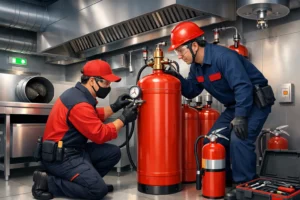
The agent cylinder is central to system performance. Inspect the cylinder for secure mounting, physical condition, service labeling, and pressure gauge readings where applicable. Low pressure, damaged hardware, corrosion, or expired service intervals are not minor notes. They are indicators that the system may not deploy correctly under fire conditions.
For some sites, cylinder pressure review is treated like a quick glance. That approach is risky. Pressure status must be read against manufacturer requirements, ambient conditions, and service history. If there is any doubt, the cylinder should be evaluated and serviced by qualified technicians.
Confirm detection line and fusible link condition
The detection network should be intact, properly routed, and free from obstruction, grease loading, or mechanical damage. Fusible links must be clean, correctly rated, and replaced at required intervals or sooner if contamination or corrosion is present.
This is one of the most overlooked items on a kitchen fire suppression maintenance checklist. Fusible links work in harsh conditions above cooking equipment. Heat, grease vapor, cleaning chemicals, and neglected hood conditions can degrade reliability over time. If links are overdue or compromised, activation cannot be trusted.
Test manual pull station access and system controls
The manual pull station must be visible, unobstructed, properly identified, and within required travel distance. Staff should be able to reach it immediately during a fire event. If the pull station is hidden behind storage, blocked by carts, or missing signage, response time is lost at the worst possible moment.
The release mechanism and control components also need inspection. Depending on system design, this may include cables, gas valves, microswitches, mechanical actuation components, and enclosure condition. Wear, tension issues, or unauthorized adjustments can affect discharge performance.
Verify fuel and power shutdown functions
A suppression system does not end with agent discharge. It must also shut down the energy source to cooking equipment where required. Gas and electric shutoff integration should be checked to confirm the sequence will operate correctly when the system activates.
This is a major compliance and life safety issue. If the wet chemical agent discharges but the appliance continues feeding heat, reflash becomes more likely. Shutdown verification should be part of regular service, especially in facilities with equipment changes, electrical upgrades, or previous repairs by multiple contractors.
Review alarm and monitoring integration
Where the suppression system is tied into the fire alarm or monitoring sequence, interface points should be verified under NFPA 72 requirements and local code expectations. Signal transmission, auxiliary contacts, and panel response all need to perform as intended.
Not every kitchen has the same level of integration, so this is an area where the checklist depends on site conditions. A stand-alone system in a small operation is different from a hotel kitchen with monitored alarm reporting, multiple zones, and documented life safety procedures. The maintenance scope should reflect that complexity.
Check inspection tags, service dates, and technical records
A compliant system needs more than working hardware. It needs traceable documentation. Review inspection tags, maintenance labels, corrective action notes, test records, and any photographs or service reports that support condition and compliance status.
For operators managing multiple kitchens, documentation gaps create serious problems. A system may have been serviced, but if the records are incomplete, out of date, or inconsistent with field conditions, the site can still face audit findings, insurance questions, or delays in proving due diligence after an incident.
What gets missed between scheduled inspections
Most failed conditions do not come from dramatic damage. They come from routine kitchen changes. Staff remove nozzle caps during cleaning and do not reinstall them. A vendor moves equipment six inches and changes the discharge path. Grease accumulates faster than expected during peak season. A shutoff valve is altered during unrelated maintenance. None of those issues look critical in the moment, but together they erode system readiness.
That is why operators should not rely only on semiannual service visits. Daily visual awareness by kitchen managers and periodic internal checks by maintenance teams can catch obvious problems before they become formal deficiencies. Internal checks do not replace certified inspection and maintenance, but they reduce the chance that a serious defect sits unnoticed over an active cooking line.
When the checklist points to repair instead of routine service
Not every deficiency belongs on a simple maintenance punch list. Some findings mean the system needs immediate corrective action, redesign, or impairment handling. Examples include mismatched appliance protection, nonfunctional shutoff integration, damaged detection lines, missing nozzles, inoperative pull stations, or cylinders outside acceptable condition.
In those cases, the correct response is not to wait for the next service cycle. The kitchen may require temporary operational restrictions until protection is restored. For hospitality operators, that decision has revenue implications, but continuing production under a compromised system creates greater exposure.
Providers that specialize in commercial kitchens typically approach this as a coordinated safety program rather than a one-time inspection. That includes suppression maintenance, hood and duct cleaning, sanitation risk review, and documented corrective actions that support audit readiness. Companies such as Fire Patrol build that discipline around the actual operating conditions of foodservice environments, where compliance has to work without stopping the kitchen unnecessarily.
Build the checklist into a preventive schedule
The strongest checklist is the one tied to a calendar, a service record, and accountability at site level. Semiannual inspections remain a core requirement for many wet chemical systems, but your real maintenance schedule may need more attention depending on cooking volume, grease output, equipment type, brand requirements, prior deficiencies, and insurer expectations.
High-production kitchens usually need tighter control. Resorts during peak occupancy, restaurants with heavy fryer use, and commissaries running long shifts put more stress on both the suppression system and the hood environment. In these operations, waiting for the next required inspection date can be too passive.
A kitchen stays safer when the checklist is treated as part of operations, not just compliance paperwork. If the system protects the most volatile equipment in the building, it deserves the same discipline as refrigeration, sanitation, and food safety controls. That is how you keep a fire event from becoming a shutdown, a claim, or a headline.