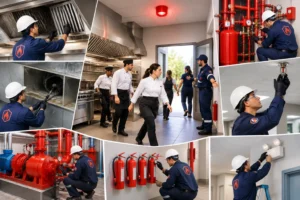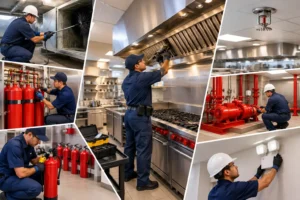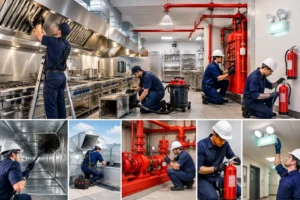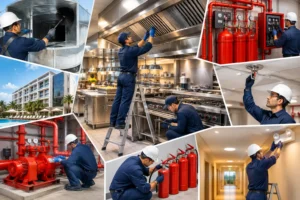
A fusible link that looks intact can still put a commercial kitchen at risk. In the context of reemplazo enlaces fusibles campana extractora, the issue is not cosmetic wear – it is whether the hood suppression system will release when heat reaches its design threshold. For restaurants, hotels, resorts, and institutional kitchens, a delayed or failed actuation can turn a contained flare-up into a shutdown, a failed inspection, or a major loss.
Why fusible link replacement in a hood system matters
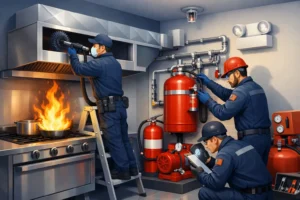
In a commercial kitchen fire suppression system, fusible links are heat-sensitive releasing devices. When they reach the rated temperature, they separate and trigger mechanical discharge. That action starts the suppression sequence, typically releasing wet chemical agent through designated nozzles to protect cooking appliances, plenum areas, and hood surfaces.
This is why replacement is not a minor maintenance item. If links are coated with grease, exposed to repeated high heat, painted over, corroded, bent, or simply left in service too long, their response can become unreliable. The system may discharge late, discharge improperly, or fail to actuate when needed.
From an operations standpoint, the risk is broader than fire damage alone. A compromised release assembly can affect NFPA inspection readiness, insurance expectations, and the owner’s ability to document that the system has been maintained according to the manufacturer’s instructions and applicable code requirements.
Reemplazo de enlaces fusibles campana extractora: when replacement is required
In most commercial kitchen suppression systems, fusible links are not permanent components. They are consumable release elements with replacement intervals tied to the manufacturer’s requirements and service conditions. In many systems, links must be replaced at least semiannually during required inspections and servicing. In harsher kitchen environments, earlier replacement may be justified.
That schedule matters because kitchens are aggressive operating environments. Heat cycles, vapor, grease residue, cleaning chemicals, and vibration all affect component condition. A link may appear physically present and still no longer be suitable for continued service.
Replacement is also required after any system actuation, mechanical discharge test, or service event that affects the detection line or releasing assembly. If the link has been contaminated during hood cleaning, damaged during maintenance, or installed incorrectly, it should not remain in service just because it has not separated.
For operators managing multiple locations, this is where inconsistency becomes expensive. One site may have current links, another may have overdue links, and a third may have mismatched temperature ratings. That is exactly the kind of issue that surfaces during an audit or after an incident.
Common conditions that justify immediate corrective action
The most common red flags are grease accumulation, corrosion, discoloration from heat exposure, deformation, missing identification, and non-listed replacement parts. Another major issue is improper orientation or tension in the cable and link assembly. Even the correct link can become unreliable if it is installed under the wrong conditions.
There is also a practical distinction between cleaning around a link and assuming the link is still acceptable for service. Once contamination is significant, replacement is usually the safer path. A low-cost component should never become the weak point in a life-safety system.
What standards and inspections are really checking
Owners and facility managers often hear that their system must be inspected, but the real value is understanding what the inspection is verifying. In a commercial kitchen suppression system, technicians are not only checking for the presence of fusible links. They are evaluating whether the releasing path remains code-compliant, manufacturer-approved, and operationally reliable.
NFPA 17A and NFPA 96 shape the maintenance framework for wet chemical systems protecting cooking operations. The inspection process typically includes review of link condition, correct temperature rating, proper placement, system integrity, nozzle condition, manual pull accessibility, cylinder status, and shutdown interfaces for fuel or electrical sources where applicable.
A serious inspection also documents deficiencies clearly. If links are overdue, contaminated, mismatched, or noncompliant with the listed system design, that should be identified as a corrective item, not treated as a minor observation. In a regulated hospitality environment, vague service notes are not enough. Audit-ready documentation matters because it demonstrates that deficiencies were found, explained, and corrected.
The risk of delaying fusible link replacement
Delaying replacement is often framed as a small cost-saving measure. In reality, it shifts risk into the busiest part of the operation – above the cooking line, during high heat, with grease-laden vapors present.
If a link does not release at the intended temperature, suppression activation may be delayed until the fire has extended beyond the protected hazard area. Once that happens, containment becomes more difficult, cleanup costs rise, and the chance of operational interruption increases sharply. A short service delay can become lost revenue, canceled bookings, failed health and safety reviews, and reputational damage.
There is also a legal and insurance dimension. After a kitchen fire, maintenance records are often scrutinized. If the system was not serviced on schedule, if links were overdue, or if unapproved parts were used, the operator may have a harder time defending maintenance practices. The issue is not only whether a fire occurred. It is whether the protection system was kept in serviceable condition.
Why «it still looks fine» is not a maintenance standard
Visual assumptions cause many avoidable failures. Fusible links are engineered to respond within specific thermal parameters. Surface appearance alone does not confirm that the eutectic element, metal condition, or release behavior remains within specification.
Commercial kitchens also vary widely. A high-volume hotel line, a steakhouse, a quick-service fryer bank, and a resort banquet kitchen do not expose suppression components to the same stress. That is why disciplined replacement schedules and brand-specific procedures matter more than guesswork.
How proper replacement should be handled
Reemplazo de enlaces fusibles campana extractora should be treated as part of a qualified suppression service process, not as an isolated swap by untrained staff. The correct replacement depends on the system manufacturer, the model of the release assembly, the listed temperature rating, and the actual appliance layout under the hood.
A proper service visit should confirm that the installed links match the system listing and the hazard application. The technician should also inspect cable routing, pulley condition where applicable, tension, release mechanism function, and any signs that grease or poor housekeeping are affecting system components. If links are replaced without evaluating the surrounding mechanism, the root problem may remain.
Documentation is equally important. Service records should identify the condition found, the corrective action performed, and any remaining deficiencies that require follow-up. For hospitality groups and multi-unit operators, photographic reporting adds another layer of control. It helps regional management verify that the system over each cooking line is not only serviced, but serviceable.
Operational mistakes that create repeat deficiencies
One of the most common mistakes is treating hood cleaning and suppression maintenance as unrelated tasks. They are not. Poorly coordinated cleaning can contaminate nozzles, disturb caps, affect fusible links, or leave residues around critical components. On the other side, suppression service performed without attention to grease conditions ignores a major source of recurring system stress.
Another mistake is replacing links with whatever part is available instead of the listed component for that system. Commercial kitchen fire protection is not a universal-parts environment. Different manufacturers and assemblies have specific requirements, and substitutions can create compliance and performance problems.
A third issue is running kitchens past service intervals because the system has not discharged. That logic fails because suppression systems are preventive safeguards. Their value is proven when they operate correctly during a low-frequency, high-consequence event. Waiting for a fire to test whether maintenance was adequate is not a defensible strategy.
What kitchen operators should expect from a qualified service partner
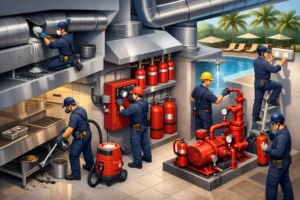
A credible provider should approach fusible link replacement as one element of a larger compliance program. That means scheduled inspections, correction of deficiencies, verification of actuation components, nozzle review, cylinder checks, manual pull evaluation, alarm interface coordination where required, and records that can stand up to audit review.
For hotels, resorts, and multi-unit restaurant groups, consistency is often the deciding factor. A disciplined service partner helps standardize inspection intervals, replacement practices, and reporting across sites. That reduces the chance that one neglected hood system becomes the location that triggers a loss, a citation, or a preventable shutdown.
This is where specialized kitchen-focused service matters. Fire Patrol works in exactly this risk environment – protecting cooking operations where compliance, uptime, and documented maintenance all have direct business consequences.
A fusible link is a small component, but in a hood suppression system it carries a large responsibility. When replacement is handled on schedule, with the correct parts, proper inspection, and clear documentation, the result is more than compliance – it is a kitchen operation that is better prepared to keep people safe and stay open when the pressure is highest.