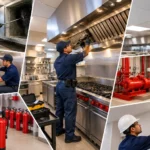

A kitchen fire claim often turns on one uncomfortable question: can grease buildup void insurance coverage? In many commercial kitchen losses, the answer is not a simple yes or no. It depends on policy language, maintenance records, inspection history, and whether the operator can show that the fire protection systems, exhaust system, and hood and duct surfaces were maintained to recognized standards.
For restaurants, hotels, resorts, and institutional foodservice operations, this is not a minor technicality. Grease accumulation is one of the clearest indicators of unmanaged fire risk in a commercial kitchen. When that buildup contributes to ignition, fire spread, or suppression system failure, insurers and investigators will look closely at whether the loss was tied to preventable neglect.
Why insurers look hard at grease-related fire losses
Insurance carriers do not usually deny a claim simply because grease was present. Grease exists in every active commercial kitchen. The issue is whether there was excessive accumulation, poor housekeeping, or a failure to maintain the exhaust and fire suppression systems in accordance with accepted practice.
After a fire, the carrier will typically review the cause and origin report, service records, cleaning logs, suppression inspection reports, and any documented deficiencies. If the hood interior, filters, ducts, fan, or rooftop exhaust components show heavy residue that should have been removed through routine service, that condition can become central to the claim review.
From an underwriting and claims standpoint, grease buildup signals three things at once. First, it increases fuel load. Second, it can interfere with suppression performance if nozzles are obstructed or if fusible links and detection components are contaminated. Third, it may suggest the operator was not following required maintenance procedures. That is where coverage disputes begin.
Can grease buildup void insurance coverage in every case?
No. But it can absolutely lead to reduced coverage, denied portions of a claim, delayed payment, or broader disputes over liability. The difference usually comes down to causation and compliance.
If a fryer malfunction causes a localized fire and the suppression system activates properly, a claim may still be covered even if the kitchen was not in perfect condition. On the other hand, if investigators determine that grease-laden ducts allowed fire to extend beyond the cooking area, or that neglected suppression components failed to discharge as designed, the carrier may argue that the insured did not meet basic loss-control obligations.
Most commercial property policies are not written as maintenance manuals. They do not say, in simple terms, that one dirty hood voids all coverage. What they often do contain are conditions related to hazard control, protective safeguards, prompt maintenance, and the insured’s duty not to increase the known risk. If the operation ignored repeated warnings, skipped cleanings, or let cited deficiencies remain open, the insurer may use that history to challenge the claim.
That is why the better question is not just can grease buildup void insurance coverage. It is whether the buildup shows a pattern of noncompliance that materially contributed to the loss.
The role of NFPA 96 and NFPA 17A
For commercial kitchens, accepted standards matter. NFPA 96 governs ventilation control and fire protection of commercial cooking operations. NFPA 17A addresses wet chemical extinguishing systems used to protect cooking equipment. These standards help define what reasonable maintenance looks like.
NFPA 96 requires the exhaust system to be inspected and cleaned to prevent hazardous grease accumulation. The required frequency depends on cooking volume and type of operation. A high-volume kitchen may need monthly service, while a lower-volume facility may be placed on a longer interval. The standard is not based on convenience. It is based on actual grease production and fire exposure.
NFPA 17A and related manufacturer requirements address inspection and maintenance of the suppression system itself. Nozzles must be in place, clean, and correctly capped where required. Fusible links must be replaced at prescribed intervals. Manual pull stations, cylinders, detection lines, and appliance coverage must remain serviceable.
If a loss occurs and the kitchen was operating outside these expectations, the carrier has a factual basis to ask whether the insured failed to maintain protective safeguards. That does not automatically end coverage, but it weakens the operator’s position.
What investigators usually examine after a commercial kitchen fire
Claims involving grease fires are documentation cases. Investigators do not rely on general statements like «we clean the hood regularly.» They look for evidence.
They will often request hood and duct cleaning reports, suppression inspection tags and service records, corrective action documentation, photos of system condition before and after service, alarm interface testing if applicable, and records showing that deficiencies were closed in a reasonable timeframe. They may also review municipal inspection reports, health department observations, landlord notices, and internal maintenance logs.
Physical evidence matters just as much. If the exhaust plenum, duct transitions, access panels, and fan hinge kit areas show layered grease deposits, that can contradict an operator’s claim of regular cleaning. If suppression nozzles are blocked by hardened residue, if appliance layout changed without system reconfiguration, or if a system was overdue for inspection, those facts can shift the claim from accidental loss toward preventable failure.
The most common insurance problems tied to grease buildup
The first problem is a denied or disputed property claim after a fire spreads beyond the cooking surface. The second is a challenge to business interruption losses, especially if the carrier argues the shutdown was extended by pre-existing code or maintenance issues rather than by the fire event alone.
A third issue appears in liability claims. If grease conditions contribute to injuries, smoke migration, tenant damage, or fire extension into other parts of the building, the operator may face questions not only from its own insurer but from other carriers and legal counsel. In a hotel, resort, or mixed-use facility, that exposure can multiply fast.
There is also a practical issue that many operators overlook. Even when a claim is paid, poor documentation can slow the process, increase scrutiny, and create costly gaps in reimbursement. Delayed claim resolution can be as damaging operationally as a partial denial.
How to reduce the risk before a claim ever happens
The strongest defense is not an argument after the fire. It is a documented maintenance program that shows the operation took fire prevention seriously and acted on deficiencies.
That starts with cleaning the hood, ducts, filters, and exhaust fan on the correct schedule for the cooking load. Quarterly service is common in some operations, but it is not universally enough. Charbroiling, wok cooking, solid fuel use, and extended high-volume production can justify much more frequent cleaning.
It also means keeping the suppression system inspection current and making sure service goes beyond a tag on the tank. Nozzle condition, caps, alignment, fusible links, cylinder pressure, mechanical actuation, and appliance coverage all matter. If equipment is moved, replaced, or added, the suppression design may need to be updated.
Documentation should be audit-ready. Good records include dated service reports, photos, noted deficiencies, corrective action completion, and proof that the cleaning contractor and suppression provider are qualified for commercial kitchen work. For operators under brand standards, franchisor oversight, or hospitality audit pressure, that discipline protects more than insurance. It protects continuity.
Can grease buildup void insurance coverage when contractors were involved?
Sometimes operators assume that if they hired a cleaning vendor, they are fully protected. That is not always how claims are evaluated. If service was incomplete, poorly documented, or performed at the wrong interval, the insured may still face scrutiny.
Responsibility does not end with outsourcing. Facility leadership should verify scope, frequency, access to all duct sections, fan cleaning, and follow-up on identified deficiencies. The same applies to suppression service. An inspection that notes obstructed nozzles or overdue fusible link replacement is only useful if the correction is completed and documented.
This is where a compliance-driven service model makes a difference. Fire Patrol works with commercial kitchens that need technical reporting, photographic evidence, standards-based inspections, and a maintenance schedule aligned with actual risk, not guesswork.
What a strong file looks like when a claim is reviewed
The best-positioned operators can produce a clean chain of evidence. They show recent hood and duct cleaning reports, current suppression inspection records, documented corrective actions, and proof that the kitchen was being maintained to recognized standards at the time of loss.
That does not guarantee a perfect claims outcome. Insurance decisions still depend on policy terms and the facts of the event. But strong records change the conversation. Instead of defending a neglected system, the operator can show a controlled maintenance environment with documented preventive action.
When a commercial kitchen handles high heat, grease vapor, and continuous production, buildup should never be treated as a housekeeping issue alone. It is a fire load, a compliance issue, and a claims issue. If your operation cannot quickly prove what was cleaned, inspected, corrected, and verified, the real problem starts after the flames are out.